"Wellcome To Our All News Update Website"

"All News Updates Is The Greatest News Based Web Site, This Website Provides : All Kinds Of News That Means All News Updates"

"Sport News"

ICC World Twenty20 2012 - groups

"Entertainment"

Australian-born, London-based artist Ralph Heimans' new official portrait of Her Majesty The Queen, has been unveiled at the National Portrait Gallery in Canberra, Australia.

A New Smartphone App

A new smartphone app aims to provide a cheaper alternative to ultrasound in Africa by bringing an old technique into the 21st century.

Can you build a human body?

We will meet a woman deciding whether to have her hand cut off for a bionic replacement and analyse the potential to take the technology even further, enhancing the body to superhuman levels.

Showing posts with label us. Show all posts

Sunday, July 01, 2012

How a mother changed the world for her daughter

How a mother changed the world for her daughter
President Lyndon B. Johnson and Patsy Mink in 1966. Mink was an author of Title IX, which bans sex discrimination in schools.

Wendy Mink was 7 years old when she decided to run for president.
But her dream was denied before she began.
"I was asked to remove my name from the ballot," Mink said. "A teacher told me that it was more appropriate for a boy to be president."
She could be a helper and run for vice president, the teacher offered.
Ten years later, Mink received a rejection letter from Stanford.  They had "reached their quota" of women for that year.
Today, the independent scholar who taught for 30 years in higher education sees how Title IX - the education act that prohibited gender discrimination in federally funded institutions - has influenced her life.
"I directly witnessed the struggle to win and implement Title IX and have been directly involved in its enforcement at the university level," she said.
A woman who went to graduate school and worked in academia, she has a professional connection to the legislation that was signed 40 years ago.
But there also is a more personal one.
The co-author of the law was her mother.

Mink was 20 years old when the legislation passed in 1972.
Her mother, U.S. Rep. Patsy Takemoto Mink, had had her own share of experiences that made her an advocate for equity in educational opportunities.
The elder Mink was rejected by more than a dozen medical schools in the 1940s because she was a woman.
"It was the most devastating disappointment of my life," she recalled in the documentary Patsy Mink: Ahead of the Majority. "That I could have spent my whole educational experience, you know, geared toward one thing and then have all the schools I wrote say 'no, can't have you.'"
She applied to the University of Chicago law school, and, she says, was accepted as part of the "foreign quota," despite being born in Hawaii.  One of only two women in her class, she later became the first Japanese-American woman to practice law in Hawaii, and then the first woman of color elected to Congress.
There she served 24 years and co-authored Title IX, the women's educational equity act, the legislation that became her legacy.
“No person in the United States shall, on the basis of sex, be excluded from participation in, be denied the benefits of, or be subjected to discrimination under any education program or activity receiving federal financial assistance," it states.
Title IX is 37 words, but 40 years later it has made innumerable changes to American education.
The law impacted education opportunity: Women now earn more undergraduate degrees than men.
It impacted athletics. In 1972, 30,000 women participated in high school sports. Now more than 3 million do.
It even influenced educational environments. The law has been used in litigation for sexual harassment and violence allegations in schools.
Analysis: 40 years after Title IX, 904% more women play high school sports
But the amendment of today almost went away.
In 1975, three years after Title IX was signed, the U.S. Department of Health, Education, and Welfare was issuing final regulations.  The amendment faced resistance from college athletic directors who fought to remove athletics regulations in the act, arguing that funds that would go to women would hurt men's sports.
As legislators when to vote on this change in Title IX, Congresswoman Mink got a call.
Her daughter, Wendy, was involved in a serious car accident at school.
The congresswoman left the floor.
The measure lost by one vote.
Later, there was a re-vote, and the amendment, as it is enacted today, passed, setting into motion a law that marks 40 years Saturday.
In 2002, when Mink died, Title IX was renamed the Patsy Mink Equal Opportunity in Education Act.
"I never had in my dreams and expectation...that it would change entirely the notion of careers for women," Patsy Mink said in Ahead of the Majority.
It allowed her daughter to move beyond running for president of her second-grade class, to actually become  a professor in higher education.
"Her hope was that the next generation would not endure the same obstacles that she had to encounter, " Wendy Mink said.

Female writers to Nora Ephron: 'I'll have what she's having'

 The romantic comedy is not a movie category necessarily known for churning out Oscar nominees, but in the capable hands of Nora Ephron, the "rom-com,"  a genre that elicits as many rolled eyes as clutched hearts, was a smart and lovely thing.
In the oft quoted scene from "When Harry Met Sally," for which Ephron earned a screenwriting Oscar nomination, Sally, played by Meg Ryan, imitates a moment of pleasure with great exaggeration, before promptly stopping and having a bite to eat.  A neighboring diner looks at Ryan, then at her waiter, and deadpans:
"I'll have what she's having."
Nora Ephron, prolific writer and filmmaker, dies at age 71

Ephron was a writer's writer: journalist, book author, playwright, blogger, editor, director. In the process, she became a symbol to a generation, similar to what  Dorothy Parker, the journalist known for her wit, was to her: an example of an intelligent, witty writer of a generation.
"I’m not going to lie: since I first learned of Nora, when I understood the body of her work, I wanted to be like her," Forbes contributor Liza Donnelly wrote.

Emily Yoffe, a Slate Magazine contributor, shared: "Of course the point of worshipping Nora Ephron was not to be her second-rate imitator, but to try to learn from her the art of writing sentences that could come from only one person."
"I'm so, so, so very sad that we've lost such a powerful and brilliant woman, but so, so, so very thankful that she gave me and so many other young men and women so many dreams," wrote comedian Meghan O'Keefe for The Huffington Post.
Nora Ephron made romantic comedies and films featuring nuanced women a familiar thing, and also mined her own life for art.

The best of Nora Ephron

She famously turned a personal fixation into her classic Esquire essay, "A Few words about breasts":
"And even now, now that I have been countlessly reassured that my figure is a good one, now that I am grown-up enough to understand that most of my feelings have very little to do with the reality of my shape, I am nonetheless obsessed by breasts. I cannot help it. I grew up in the terrible '50s — with rigid stereotypical sex roles, the insistence that men be men and dress like men and women be women and dress like women, the intolerance of androgyny — and I cannot shake it, cannot shake my feelings of inadequacy."
The heartache and meltdown of her marriage to her second husband, Carl Bernstein, became fodder for a novel, then movie. "Heartburn," the fictional story based on the end of that marriage, was a best-seller, and further established her as a literary voice and screenwriter.

Love, loss and what Nora ate

In a 1996 commencement speech at her alma mater, Wellesley, Ephron told graduates:
"This is the season when a clutch of successful women - who have it all - give speeches to women like you and say, to be perfectly honest, you can't have it all. Maybe young women don't wonder whether they can have it all any longer, but in case any of you are wondering, of course you can have it all. What are you going to do? Everything, is my guess. It will be a little messy, but embrace the mess. It will be complicated, but rejoice in the complications. It will not be anything like what you think it will be like, but surprises are good for you. And don't be frightened: You can always change your mind. I know: I've had four careers and three husbands."
She offered a template for a generation of women then, and now, to get a chance to have what she had.

Are voters ready to move on?


President Barack Obama reacts Thursday at the White House following the Supreme Court's health care ruling.
President Barack Obama reacts Thursday at the White House following the Supreme Court's health care ruling
Follow him on Twitter. With the Supreme Court's thunderbolt, a crucial battle is over on health care, but the war surely goes on. Or does it?
There has been a widespread view among conservatives that if the court were to uphold Obamacare that would do more to galvanize the tea party and other parts of their base than any other outcome. Anger and frustration can be powerful motivators in politics.
On cue, Mitt Romney immediately seized upon the court's decision to whip up Republican voters, arguing that now the only way to replace Obamacare is to replace President Obama. House Republicans are promising a quick, symbolic vote to overturn the law after July Fourth. And conservative groups are preparing to pour in millions of dollars in ads against the Patient Protection and Affordable Care Act that will begin hitting as early as Friday.
David Gergen
David Gergen
Opinion: Health care victory, but still a long way to go
Clearly, the war moves to a new front as far as the right is concerned. And in truth, the GOP should be able to mobilize a higher turnout from its base this November.
But the base alone will not be enough to win: The GOP also needs to draw in boatloads more of moderate and centrist voters. And whether those folks are going to welcome new rounds of fighting over the health care law remains to be seen.
My hunch is that a sizable number will think the war over health care has gone on long enough, and they will want to move on to more important issues. Jobs and deficits have long been trumping health care around most dinner tables.

 
Obama: It's a victory for the people
 
Romney: I'll do what justices didn't
 
How will the court's ruling affect you?
 
Short-term loss for conservatives?
 For better or worse, the court struggle came to be seen as the decisive battleground in trying to repeal the health reform law. Partisans on both sides, along with the press, created an expectation that the court would strike down the mandate, the keystone in the arch. Obama would be shown as another ineffectual Jimmy Carter, losing much of his authority.
Opinion: Liberty lost? The Supreme Court punts
But now that the court has spoken definitively on behalf of Obama -- and even Chief Justice John Roberts sided with the president -- there is likely to be a sense that the dam has broken. Especially among those who have been ambivalent about health care reform legislation -- and there are millions who like portions of it even though they don't much like it overall -- psychology may change. "Time to give it a rest; let's get our focus back to the economy."
How the public responds to the health care decision over the next couple of weeks will be critical. This is a moment when tides could shift.
Obama was smart in his reaction to the court: He didn't gloat too much over his huge victory, and he left open the door to alterations in the law in the months ahead. After some weeks of stumbling, he seemed presidential.
Romney is riding a tiger: To stay on top, he must continue to give voice to the tea party -- and if he falls off, as the joke goes, they will eat him. But a series of strident attacks against Obama and his health care plan will not be enough. To win, he must also reach voters beyond his base, showing that he understands their concerns and will speak for them, too.

Wildfire evacuee: Burglary 'almost as bad as the house being burned down'

Homes destroyed by the Waldo Canyon fire are seen from the air in a neighborhood on Saturday, June 30, in Colorado Springs, Colorado.The massive fire has destroyed hundreds of homes and forced more than 36,000 people to flee. Hundreds displaced by a fast-moving wildfire outside Colorado Springs, Colorado, will get their first look Sunday at what remains of their homes when authorities begin bus tours of burned out neighborhoods.
Authorities were still tallying the toll over the weekend from what state officials described as the worst fire in the state's history, though preliminary estimates by fire officials put the devastation at nearly 350 homes destroyed and more than two dozen damaged. Two people were killed and two were wounded in the fire, authorities said.
By early Sunday morning, firefighters contained 45% of the so-called Waldo Canyon fire, which has scorched more than 17,600 acres -- close to 27 square miles -- since it began June 23.
Firefighters, aided by helicopters, air tankers and military planes dropping water and retardant, fought to contain the inferno that early Sunday was still threatening 15,000 homes and 140 businesses, according to InciWeb, a multi-agency fire response website.
Crews were working through the early morning hours, fighting spot fires that could flare up and make a run at threatened communities.
"If we can get in and clean things up tonight, it will really help," said Kim Soeper, a fire chief overseeing night firefighting operations, Saturday night.
The city has organized the tours, which will continue through Monday, for about 4,000 people in neighborhoods that were either damaged or destroyed by the wildfire.
"You'll be able to look at your property," Steve Cox, assistant to the Colorado Springs mayor, told reporters over the weekend. "You're not going to be able to get out and walk around the property because we're still in an active fire situation."
The fire forced the evacuation of more than 36,000 people, most on Tuesday when strong winds whipped the blaze into a firestorm that spewed ash and smoke.
Many have since been allowed to return. Authorities are no longer keeping track of how many people are still evacuated, said Anne Rys-Sikora, a spokeswoman for the U.S. Forest Service.
But thousands early Sunday were still waiting for word when they would be able to go home.
Among those who no longer have a home is Nicole Frye. She learned her house was among those destroyed when the wildfire roared down the mountain into the western subdivisions of Colorado Springs.
Frye has not returned yet but has seen the devastation in aerial photographs.
Authorities warned Saturday that those returning home should be on the lookout for wild animals, including bears, driven into communities by the wildfire.
They also warned residents to be on the lookout for possible burglars targeting houses vacated by mandatory evacuations.
More than 150 National Guard soldiers were deployed to Colorado Springs to back up police, who are investigating nearly two dozen burglaries or attempted burglaries in the evacuation zones.
Linda Burton evacuated her suburban home because of the advancing wildfire only to return to find out her house was burglarized.
"It's almost as bad as the house being burned down because you feel violated that there are people out there that prey upon victims that are already suffering," Burton told CNN affiliate KKTV.
"I feel like I have been hit by a train."
But there are signs of progress in Colorado Springs, says Cody Muth, a graduate student at the University of Colorado.
"It's still a little strange," said Muth, who days earlier helped a friend flee the firestorm.
Stores and gas stations, he said, have begun to reopen. The heavy smoke that blanketed portion of the city for days has also begun to lift.
But still, he says, people are wary.
"It's just kind of hard to cope with. Your city was on fire, and every day you see a new plume of smoke in the distance," he said.
"That's how all of this started, a plume of smoke in the distance."
Authorities put the cost of fighting the fire at $8.8 million by Saturday night. The U.S. Forest Service has warned it could be mid-July before the Waldo Canyon Fire is fully under control.
The wildfire is one of 11 active fires in Colorado. Other Western states -- including Idaho, Wyoming, and Utah -- also are battling wildfires, which is straining firefighting resources.
President Barack Obama declared Colorado a disaster area to allow federal dollars to help fight the Waldo Canyon Fire as well the High Park Fire, which burned 87,284 acres and destroyed nearly 260 homes in northern Colorado since it began on June 9.
As of Saturday night, that fire was 100% contained and all evacuation orders were lifted. Firefighters will continue mopping up hotspots along the perimeter of the fire, which has cost more than $38 million to date.

Wednesday, June 27, 2012

Colorado wildfire of 'epic proportions' displaces 32,000; tests firefighters


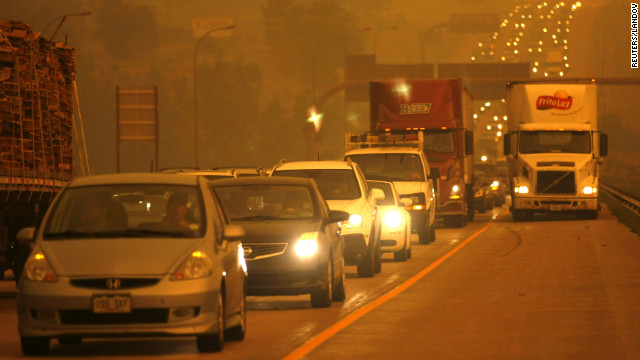
Smoke from the Waldo Canyon Fire engulfs Interstate 25 north of Colorado Springs, Colorado, as the blaze burns out of control Tuesday, June 26. The 6,200-acre Waldo Canyon Fire has caused 32,000 residents to be evacuated. At least six other fires are active in Colorado.


Predicted thunderstorms could complicate efforts Wednesday to tame an explosive wildfire that has already chased some 32,000 residents from their homes near Colorado Springs, Colorado.

The fire doubled in size overnight and by Wednesday morning, 15,324 acres were burning with only 5% contained, said Rich Harvey, incident commander of the Waldo Canyon Fire.
"You saw yesterday as bad a fire behavior as you are going to see anywhere, anytime," he said, referring to extremely dry, hot and windy conditions. "We expect further trouble from the weather today."
Thunderstorms seem like a good thing in the midst of hot, arid conditions, but they bring with them strong winds that can gust in any direction. "That will make work for firefighters more difficult," Harvey said.
Open Story: iReporters share their harrowing views of the western wildfires

 
Colorado wildfires force evacuations
 
Evacuee: Wildfire 20 feet from home
 
Evacuees watch and hope homes remain
 
'Smoke plume was coming toward us'
 
Winds gusting to 65 mph through mountain canyons blew the wildfire through containment lines into northwest Colorado Springs on Tuesday afternoon.
Richard Brown, the Colorado Springs Fire chief, described it as a "firestorm of epic proportions."
Gov. John Hickenlooper surveyed the Waldo Canyon Fire, telling reporters it was a difficult sight to see.
"There were people's homes burned to the ground. It was surreal," he said late Tuesday night. "There's no question, it's serious. It's as serious as it gets."
Becky Schormann has nervously listened to news reports since Saturday, the day the fire started, prompting her to evacuate the area with her husband.
She hoped her home would be spared.
The family managed to take some sentimental items with them when they left, but still had to leave behind a boat, a pair of ATVs, a China cabinet and an antique doll collection.
"I keep telling myself: It's going to be okay," she said.
Schormann told CNN that flames came to within 20 feet of their home but were beaten back.
"Our volunteer fire department is just awesome," she said.
The Schormanns are staying in an RV at their daughter's home. The family's two dogs, a pony and a donkey also came along for the ride.
The flames from the same wildfire also are dangerously close to the U.S. Air Force Academy campus. An evacuation order has been issued for about 700 residents in its Pine Valley Housing and 1,400 in Douglass Valley Housing, said public affairs officer John Van Winkle.
The academy's powered flight, glider and parachuting operations have been called off since Saturday so that the U.S. Forest Service could use runways for helicopters used to fight fires along Colorado's Front Range, Van Winkle said.
The academy's Class of 2016, all 1,045 cadets, will arrive Thursday.
"The fire conditions could not be worse," said Anne Rys-Sikora, spokeswoman for a multi-agency fire response team. "It is like a convection oven out there."
Colorado Springs set a record high of 101 on Tuesday as firefighters contended with brutal conditions, including ash falling on highways and neighborhoods. Officials rushed in crews and aerial equipment in a bid to slow the fire.
The forecast stays hot and dry for the foreseeable future, with daytime highs not falling out of the 90s until early next week, according to the National Weather Service.
Dave Barjenbruch, a meteorologist with the National Weather Service office in Boulder, said the past week has been hellish across Colorado.
"Even in the foothills, where most of the fires are going on, most days have been in the single-digit humidity," he said.
Meanwhile, a new fire in Boulder, northwest of Denver, prompted pre-evacuation notices to 2,300 phone numbers.
Six other wildfires were active in the state, according to the Colorado Division of Emergency Management.
The largest of the fires was the High Park Fire, which began June 9 and has now consumed 87,284 acres, the U.S. Forest Service said. It was 65% contained Tuesday. The total number of homes lost rose to 257. An estimated $33.1 million has been spent trying to contain the blaze.
The Federal Emergency Management Agency authorized the use of federal funds to help fight the Waldo Canyon Fire after Colorado Springs and surrounding El Paso County declared an emergency, which allows them to receive state and federal aid.
A large section of neighboring Utah was under a red-flag warning, with at least three wildfires burning Tuesday.
Authorities said they found the body of one person after they entered the evacuated areas of the Wood Hollow Fire, about 30 miles south of Provo. The victim had not been identified, according to the Sanpete County Sheriff's Office
FEMA is providing funds to help fight the Wood Hollow Fire, which has grown to 46,190 acres since starting Saturday afternoon. Containment was 15%.
West of Provo, the Dump Fire stood at 5,007 acres and was 100% contained, officials said.

Growing Evidence of Agent Orange in Japan

Growing evidence indicates that during the U.S. occupation of Okinawa from 1945 to 1972, the U.S. violated a treaty to not store herbicides within Japan's political boundaries. Accusations that the defoliant Agent Orange was present in Japan in the late 60s, is gaining ground as the latest reports point to a massive stockpile apparently disposed on the grounds at Futenma air station in Okinawa after the end of the Vietnam War. Former Lt. Col. Kris Roberts said he unearthed hundreds of rusty barrels leaking the defoliant in 1981.
However, despite repeated allegations that the U.S. military stored, transported and even buried hundreds of barrels of Agent Orange in Okinawa, the Pentagon continues to deny the accusations.
Ex-U.S. serviceman Larry Carlson says he saw it sprayed as a weed killer at Kadena Air Force Base in Naha and was later granted benefits from the U.S. government due to the resulting illnesses derived from the exposure. Carlson says the toxic defoliant was stored on Okinawa and then loaded onto merchant ships such as the USS Comet and the SS Transglobe, headed to Vietnam. But Carlson remains the only ex-service man in Okinawa to receive health care benefits from the U.S. government.
Ex-serviceman Michael Jones and longshoreman James Spencer both confirmed that Naha's port was used to transport thousands of barrels of herbicide, including Agent Orange.
Joe Sipala, a former U.S. Air Force mechanic who runs a Facebook Page, Agent Orange Okinawa, says he sprayed the defoliant regularly as a weed-killer at the Awase Transmitter Site in Okinawa and that he now suffers from multiple diseases as a result.
2012-06-19-JoeSipala.jpg
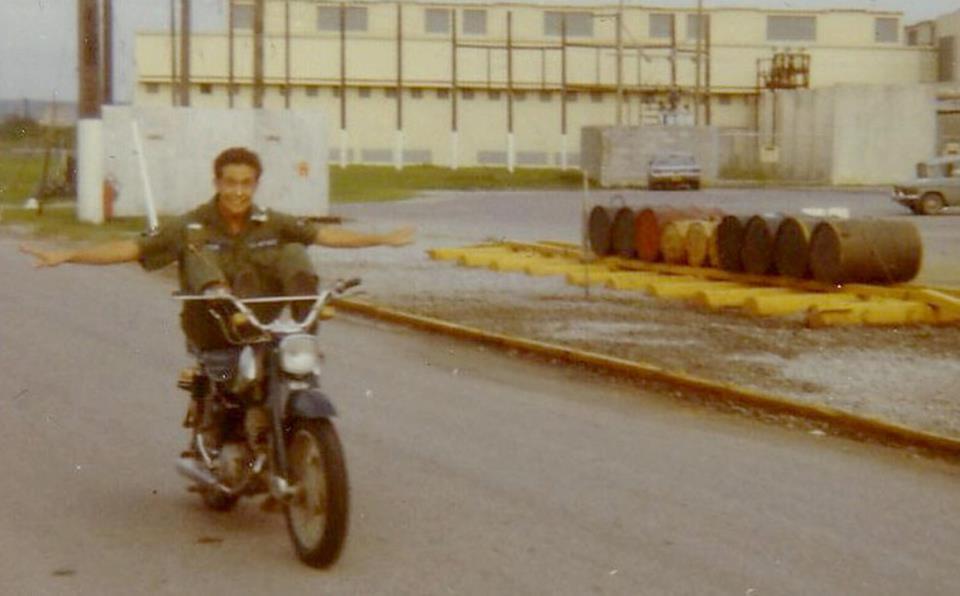
Joe Sipala rides his motorcycle next to a barrel of Agent Orange (third from left) on Okinawa in 1970. PHOTO COURTESY OF JOE SIPALA
Former marine Scott Parton alleges that he saw barrels of Agent Orange on the Camp Schwab base in 1971.
Another vet, who prefers to remain anonymous, said that in the late 1960s, the U.S. military buried barrels of Agent Orange in an area around Chatan. As a forklift driver at a U.S. Army supply depot at that time, he said he helped load Agent Orange onto trucks to transport it to a port in Naha, from which they would be loaded onto ships headed to Vietnam. Yet another vet says that in 1969 he saw barrels of agent orange buried in a 45-meter-long trench at Hamby Air Field.
Most affected vets have not been able to receive health benefits, in large part due to the government's refusal to admit the defoliant was ever present on Okinawa. In July of 2004, chairman of the Joint Chiefs of Staff, General Richard Myers, declared that government "records contain no information linking use or storage of Agent Orange or other herbicides in Okinawa."
However, a history of misconduct suggests otherwise. In the 60s, when suspicions were aroused among Okinawan residents that the U.S. military was storing biochemical munitions, the authorities denied the claims. However, they were forced to take action when a leak of nerve gas sickened 23 U.S. soldiers in 1969. As a part of Operation Red Hat, 12,000 tons of chemical munitions was removed from Okinawa and transferred to Johnston Atoll in the middle of the Pacific Ocean.
The denial of the Department of Defense that Agent Orange was ever on Okinawa means the affected servicemen cannot receive benefits despite their apparent exposure. "I will continue the fight to get both the Japan and American governments to recognize Agent Orange was used on Okinawa," Sipala told me in an interview.
Jon Mitchell, a British journalist who has worked diligently to uncover evidence and expose veterans' stories, hopes his efforts will affect a change. "All of us are seeking justice for the thousands of veterans potentially exposed and the Okinawan civilians poisoned by these chemicals. This is not a political issue -- it's a human rights issue and an environmental tragedy. Time is running out for these service men and women -- and the U.S. government needs to come clean and help them before it's too late," Mitchell said via email. He hopes more men and women exposed to the defoliant on Okinawa will come forward.
Amy Chavez is author of 'Japan, Funny Side Up' and the forthcoming 'Running the Shikoku Pilgrimage: 900 Miles to Enlightenment' (summer 2012)

Friday, July 29, 2011

"Oliver and Olivia top baby names' list again"

Oliver and Olivia were the most popular baby names across England and Wales in 2010 for the second year running, figures show.
The top four boys' names - Oliver, Jack, Harry and Alfie - all held their popularity, the Office of National Statistics' 2010 list shows.

There were no new entries in the girls' top 10, but Sophie, Emily, Lily and Amelia all rose into the top five.

Ollie was the fastest rising name in the boys' top 100 while Olly was 113th.

When looking at the figures just for Wales, Oliver and Ruby were the most popular boys' and girls' names.

In eight of the English regions, Oliver was the most popular name, however Jack came top in the North East.

Among baby girls, Olivia was the top name in seven English regions, Sophie was the most popular in the East and Lily in the South West.

The top 10 boys' names in order were: Oliver, Jack, Harry, Alfie, Charlie, Thomas, William, Joshua, George, James and Daniel.


The name Ollie saw the largest rise of any name in the top 100, rising from 115 in 2009 to 63 in 2010.

Bobby, Caleb, Jenson, Dexter and Kayden were new entries into the top 100.

The most popular girls' names were: Olivia, Sophie, Emily, Lily, Amelia, Jessica, Ruby, Chloe, Grace and Evie.


The name Maisy saw the highest rise in popularity, rising from 141 in 2009 to occupy the 100th place in the list for 2010.

Annabelle, Eliza, Laila, Maryam and Maisy were the five new names for girls on the list.

Figures released at the end of last year by the General Register for Scotland and Northern Ireland's Statistics and Research Agency showed that Jack and Sophie were top of both lists.

"Crowds expected to gather for Edinburgh royal wedding"

Scotland's first royal wedding in nearly 20 years is set to draw crowds in Edinburgh on Saturday.

Zara Phillips is to tie the knot with England rugby star Mike Tindall at the Canongate Kirk on the Royal Mile.

The Queen and Duke of Edinburgh and other royals will join Zara's parents, Princess Anne and Captain Mark Phillips, at the ceremony.

Princess Anne's second marriage to Timothy Laurence was the last Scottish royal wedding in 1992.

Also believed to be attending are Prince Charles and Camilla, Duchess of Rothesay, the recently wed Earl and Countess of Strathearn, Prince Harry and the Earl of Inverness and his daughters, Princess Beatrice and Princess Eugenie.

Lothian and Borders Police have been working with the palace and Edinburgh City Council to ensure the smooth running of the wedding.

Supt Ivor Marshall, who is the Silver Commander responsible for overseeing security arrangements, said the event was expected to attract significant public interest, despite being a private affair.

He said: "In some ways it is quite difficult to predict, however given the couple's status as well-known sports stars, the fact many of their guests are going to be well-known, and the fact Zara is a member of the Royal Family, that's going to draw people to the event and we are preparing for that."
 
'Enjoyable day'

Supt Marshall said the kirk's location, close to both the Scottish Parliament and the Palace of Holyroodhouse, yet set on the busy tourist hub of the Royal Mile, presented unique challenges.

While some road closures will be in place, local businesses will remain open and residents, who have been contacted by Edinburgh City Council, will be relatively unaffected.

He said: "The police planning unit is well versed in assisting in the organisation of high-profile and large-scale events in Edinburgh, including the recent Royal Week, the Papal visit last year and the festival.
Continue reading the main story
“
Start Quote

Situated on the Royal Mile, there can be few more historic or romantic places in which to get married”
Mike Cantlay
VisitScotland

"Therefore, we will be drawing on that experience to keep policing costs to a minimum and ensure it's an enjoyable day for the couple, their guests and the public."

Police began security preparations immediately following the announcement of Canongate Kirk as the venue.

However, few details of the wedding have been released by the palace.

The nuptials of Zara Phillips and Mike Tindall are being billed as a low-key affair - in stark contrast to the recent wedding of the Duke and Duchess of Cambridge.

William and Kate's televised marriage was watched by a world-wide audience of hundreds of millions and attended by a host of celebrities and dignitaries.

The doors of the Canongate Kirk are to be closed to the press and public.

Tourism opportunity

But large crowds are still expected in Edinburgh's Old Town to watch the arrival of the royal family.

Mr Tindall is likely to have invited some of England's best-known rugby players who are colleagues and friends.

The wedding reception will be held in the Palace of Holyroodhouse - the official Scottish home of the Queen.

Tourist bosses said the nuptials are good news for the capital and the country.

Mike Cantlay, chairman of VisitScotland, said: "The wedding between Zara Phillips and Mike Tindall is wonderful news for Edinburgh and the whole of Scotland.

"It's a great opportunity for tourism in this country and we would urge businesses to take advantage of this great occasion.

"With the Palace of Holyrood, Edinburgh Castle and Royal Britannia, the city has a fantastic wealth of royal attractions for visitors, and I would like to congratulate Ms Phillips and Mr Tindall on choosing Edinburgh's Canongate Kirk as the venue for their wedding.

"Situated on the Royal Mile, there can be few more historic or romantic places in which to get married."

"Grant Shapps backtracks on two-year tenancy limit"

Controversial plans to end "council houses for life" in England look set to be watered down after concerns about their impact on vulnerable tenants.
Under laws passing through Parliament, social tenants could face eviction after just two years in their home.

But Housing Minister Grant Shapps has instructed regulators to ensure that the minimum period is five years in all but the most extreme circumstances.

Tenants are currently guaranteed tenure for life.

But Mr Shapps believes that can lead to families being trapped in cramped accommodation, while others live in homes that are too large for their needs.

He also believes it acts as a disincentive to social tenants to seek work and improve their income.
Market rates

Under the government's Localism Bill, due to become law later this year, social landlords will be able to evict tenants after two years.

The planned law says eviction should only be considered in exceptional circumstances - but did not state what such circumstances would be or what the alternative time limit should be.

In a letter to homeless charities and other interested parties, Mr Shapps confirms that five years will be the standard minimum time.

"We are now proposing that this expectation that tenancies of this length should only be used exceptionally should become a requirement with the Tenure Standard itself.

"If social landlords decide that there are exceptional circumstances where tenancies of less than five years may be appropriate, then they will be required to set out in their tenancy policy what those circumstances will be."

The change of policy comes as the government launches a consultation exercise on its planned shake-up of social housing, which also includes allowing landlords to charge rent at close to market rates and making it easier for tenants to swap homes.
'Positive step'

Roger Harding, Shelter's head of policy, welcomed the change to a five-year minimum but said ending lifetime tenure could still have a devastating effect on vulnerable families with children.

"While this is a positive step, we don't see it as a particularly firm base for someone to be regularly faced with prospect of eviction.

"It is far better to give someone a stable home as a base for getting them back on their feet," he told the BBC News website.

He also suggested it would be costly to administer - and questioned the wisdom of "spending a lot of time arguing about a policy that won't have any effect for 20 years because it applies to new tenants when we face an immediate affordability crisis.".

And he pointed to research undertaken in New South Wales, Australia, which suggests that far from acting as a "springboard" for people to improve their income, as Mr Shapps claims, tenants will be deterred from seeking work for fear of losing their home.

Research author Professor Suzanne Fitzpatrick, of Heriot Watt University said: "The Australian (NSW) experience calls into question the efficacy of the policy now proposed in England, given that so few of their fixed-term tenancies have been terminated, generating a negligible number of additional vacancies, but raising serious concerns about work disincentives."

"Few convictions under law for using prostitutes"

A law intended to criminalise men who use prostitutes has led to just 43 convictions in England and Wales in its first year of operation.
Figures released to the BBC show that in some regions not one man was convicted for having sex with a woman who had been forced into prostitution.

Police say the law is difficult to enforce as it relies on women coming forward to give evidence of coercion.

Supporters say the legislation will take time to become fully effective.

The law, officially known as Section 53A of the 2003 Sexual Offences Act, is meant to reduce the number of trafficked women who work as prostitutes.

It allows police to prosecute men who have sex with women even if they did not know the woman had been forced to work as a prostitute.
 
'Simplification' call

Greater Manchester Deputy Chief Constable Simon Byrne, who is the Association of Chief Police Officers' lead on the issue of prostitution, said he was "surprised" at how many convictions there had been because the law "is difficult to prosecute".

Speaking to the PM programme on BBC Radio 4, Mr Byrne said: "The whole law in relation to this particular part of policing is confusing. We are calling for a simplification.

"We are looking at a range of options in dialogue with the Home Office to try and simplify things and to look at good models of practice in other parts of the world."

Acpo claimed last year that at least 2,600 prostitutes working in brothels in England and Wales had been trafficked from abroad, almost one in 10 of the estimated 30,000 working prostitutes.

But those figures are disputed by people working in the sex industry. They argue that most women are engaging in consensual sex, simply to earn money.

Niki Adams, from the English Collective of Prostitutes, says the law does not address the fundamental issues.

"I don't think this law should be used at all," she told the BBC. "It undermines sex workers' safety and it targets the wrong people. It targets clients who may be involved in consenting sex rather than the rapists and traffickers who should be targeted by the police."

The overall aim of the legislation was to dissuade men from using prostitutes, as men can be convicted even if they did not know the woman was coerced into selling her body.
 
'Organised crime'

The law was championed by many women in the last Labour government, including the former Solicitor General, Vera Baird.

She disputes that the 43 convictions show the law is proving ineffectual - but says it does need support.

"It needs to be promoted and the government has to do that," she said Ms Baird.

"They need to make very clear to these men just what they are sustaining. Prostitution is part of organised crime, these are not just isolated women - a huge proportion of them are run by pimps."

Despite the police's call for clarity, the government told the BBC that it has no plans to change the law on prostitution.

A Home Office spokeswoman said: "Police are well equipped to use Section 53 legislation and we want to see them do so."

"MPs set to debate public's petition demands"

Campaigners who gather more than 100,000 petition signatures could have their ideas debated in Parliament, via a newly launched government website.

The e-petitions site, which will ask the public for proposals, is aimed at "building confidence" in MPs' work.

House of Commons leader Sir George Young said politicians could not afford to be complacent and had to give a "megaphone" to people's concerns.

But Labour has said the petitions could lead to debates on "crazy ideas".

The system, launched on Friday, replaces the existing e-petitions pages on the Downing Street website, set up under Tony Blair.

It allows popular petitions to be discussed by the backbench business committee of MPs, which has the power to propose debates on non-government matters.
 
'Transparent'

But some proposals, including those judged to be "libellous or offensive" or "related to honours and appointments" will be barred from the website.

Posting more than one petition on a single subject is also banned.

Sir George, a Conservative, said: "Today's launch represents another step towards a more accessible and transparent Parliament."

He added: "In recent weeks, Parliament has been at the centre of public interest, by leading the debate on phone-hacking allegations.

"But this shouldn't mean that Parliament becomes complacent. There's much more that we can do to build confidence in the work of the House of Commons and we should continue to find new ways of encouraging people to engage.

"The public already have many opportunities to make their voices heard in Parliament, and this new system of e-petitions could give them a megaphone."

However, Sir George said: "Of course, parliamentary time is not unlimited and we want the best e-petitions to be given airtime - so we will monitor the site closely over the coming months to assess whether the 100,000 figure is an appropriate target."
 
'Greater engagement'

Deputy Leader of the House, Lib Dem MP David Heath, said: "The e-petitions website is the latest example of how the coalition is continuing to take forward its programme for government.

"It underscores our commitment to reform of the parliamentary process, and will help to reinforce the aim of greater engagement by people in the politics of this country."

Petitions will be moderated by government departments, with oversight from the Office of the Leader of the Commons.

The plans were first set out in the Conservatives' 2010 election manifesto.

Petitions were introduced to the Downing Street website by Tony Blair.

The most popular, with more than 1.8 million people in support, opposed road pricing.

More than 70,000 backed the one-word suggestion that Gordon Brown should "resign".

And almost 50,000 signed up to the idea that TV presenter Jeremy Clarkson should become prime minister.

"MoD to cut further 7,000 civilian jobs"

Thousands of civil servants are to lose their jobs at the Ministry of Defence, in addition to some 25,000 posts that were already set to be cut.

The Guardian has seen a letter, being sent out by the department's top civil servant, which says a further 7,000 civilian jobs are to be cut in a bid to bring its budget under control.

The letter says the MoD needs to "bear down further on non-front line costs".

Union leaders and defence officials have expressed concern at the decision.

The cuts were not mentioned in Defence Secretary Liam Fox's last statement to Parliament, which revealed significant extra cuts to Army numbers.

The MOD is already trying to cut some 25,000 civilian posts over the next few years, as announced last October in the defence review.

Questions remain

That review outlined the future shape and size of Britain's armed forces, with defence spending set to fall by eight per cent over four years.

The decision taken to close more jobs will bring numbers at the MoD down by around a third over a period of nine years - to about 53,000 civilian posts by 2020.

The letter outlining the further job losses is signed by the permanent secretary, Ursula Brennan, and is being sent to all civilian staff.

It argues that the cuts are necessary and concedes that the move will raise questions which cannot "be answered immediately".

It expresses a hope that many of the job losses will be achieved by "natural wastage", with "compulsory redundancy" only being used as a last resort.

"Tom Watson MP: Hacking Sara Payne's phone would be 'ultimate betrayal'

The hacking of Sara Payne's phone by News of the World would represent "the ultimate betrayal", Tom Watson has said.

The MP, who sits on the Culture and Media Committee in the Commons, has led a campaign against phone hacking.

The mother of murder victim Sarah Payne has been told she may have been the victim of phone hacking, her charity has said.

Police told Sara Payne her details were in notes compiled by private detective Glenn Mulcaire, who was used by the News of the World, which championed her Sarah's Law child protection campaign.

Rebekah Brooks, who left her role as News International chief executive in the wake of the hacking scandal but denies having had any knowledge of the practice while at the paper has said in a statement: "These allegations are abhorrent and particularly upsetting as Sara Payne is a dear friend".

" Phone hacking: Murdoch may be recalled by MPs"

A committee of MPs will be asked to recall News International chairman James Murdoch to give more evidence on phone hacking.

Labour MP Tom Watson said he would also call for ex-News of the World editor Colin Myler and the paper's ex-legal manager Tom Crone to answer questions.

Mr Murdoch told MPs he had not been "aware" of an email suggesting hacking went wider than a "rogue" NoW reporter.

Mr Myler and Mr Crone have both disputed this.

The News International chairman told the Commons culture, media and sport committee earlier this month that he was not aware of a key document - known as the "for Neville" email - when he approved an out of court settlement with Gordon Taylor, the Professional Footballers' Association chief executive.

But the two former NoW executives later released a statement saying they did inform him of the email.

Mr Murdoch later said he "stands by his testimony" to the committee.

Mr Watson told BBC Two's Newsnight programme he will make the recall requests to the committee on Friday "so that we can get to the bottom of this, find the facts and Parliament can then move on and let the police do their inquiry".

The committee is due to hold an internal meeting, which will be closed to the public, on Friday morning.

Regarding the emails, in April 2008, Mr Murdoch authorised the payment of an out-of-court settlement of more than £600,000 to Mr Taylor over the hacking of his phone.

He has said at the time he did not know the full extent of hacking that may have been going on at the NoW.

That paper's royal editor Clive Goodman and private investigator Glenn Mulcaire were both been jailed for hacking into phones of the royal household in 2007.

But the email in question was marked "for Neville" and is said to have implied the NoW's chief reporter Neville Thurlbeck was also implicated in malpractices.

The latest development comes after the mother of murder victim Sarah Payne learned she may have been a phone hacking victim.

Police told Sara Payne her details were in notes compiled by Mulcaire, who was used by the NoW, which championed her Sarah's Law child protection campaign.

According to a report in the Guardian, the evidence uncovered by police in Mulcaire's notes is believed to relate to a phone given to Ms Payne by the NoW's then-editor Rebekah Brooks "as a gift to help her stay in touch with her supporters".

The BBC has not been able to confirm whether the evidence relates to this particular mobile.

But Mrs Brooks, who left her role as NI chief executive after the hacking scandal but denies having had any knowledge of the practice while at the paper, says the phone "was not a personal gift".

She said the allegations were "abhorrent and particularly upsetting as Sara Payne is a dear friend".

'Absolutely devastated'

A source close to Mrs Brooks says she believes the voicemail system on the phone provided by the NoW was not activated until 18 months ago.

In such circumstances, it would be difficult for prosecutors to prove that any voicemail interception took place.

In a statement, Ms Payne's charity, Phoenix Chief Advocates charity, said she is "absolutely devastated" by the claims.

News International said it would co-operate fully with any potential criminal inquiries or civil proceedings which may arise.

The Metropolitan Police's Operation Weeting is investigating claims of phone hacking at the paper, which was shut down earlier this month after it emerged that the phone of murder victim Milly Dowler may have been hacked.

Thursday, July 28, 2011

"Lockerbie bomber seen on TV rally"

The man convicted of blowing up a plane over the Scottish town of Lockerbie in 1988 has appeared at a rally broadcast by Libyan state television.

Abdelbaset al-Megrahi was released from prison in Scotland almost two years ago on health grounds.

Introducing him at a televised rally of members of Megrahi's tribe, the presenter said his conviction was the result of a conspiracy.

He said his release had been a victory against oppression.

The 1988 bombing of the US airliner, flying from London to New York, killed 270 people.


Megrahi was convicted of the atrocity in 2001 but released in August 2009 on compassionate grounds, as he was suffering from prostate cancer.

The Scottish government judged that he had about three months to live.

Megrahi returned to Libya, since when he has rarely been seen in public.

During the broadcast from Tripoli, which was described as live, Megrahi was seen in a wheelchair.

After playing the national anthem, a presenter said "half of the world conspired against" Megrahi.

"Fewer teenagers drinking alcohol"

kThere have been falls in the numbers of teenagers drinking, smoking and taking drugs in England, a survey suggests.
Between 2009 and 2010 the percentage of 11-15 year olds who had tried alcohol fell from 51% to 45%.

And 27% of pupils said they had smoked at least once, while 18% had tried drugs.

The NHS Information Centre figures also suggested "a shrinking number think that drinking and drunkenness is acceptable".

The report surveyed 7,296 pupils from 246 schools.

The proportion of those drinking alcohol in the week before the study fell from a peak of 26% in 2001 to 13% in 2010.

When they did drink, six in 10 pupils said they consumed more than four units.
 
Smoking

One in 20 pupils said they were a regular smoker and girls were more likely to smoke than boys.

Smokers were also more likely to have drunk alcohol or to have taken drugs.

In 2001, 29% of those surveyed said they had used other drugs. That figure has fallen to 18%.

The most commonly used drug was cannabis, taken by 8.2% of pupils.

The survey also suggested a shift in attitudes.

Between 2003 and 2010, the percentage of pupils saying it was "okay" for someone their own age to drink once a week went from 46% to 32%.

Tim Straughan, chief executive of the NHS Information Centre, said: "Our figures point to an increasingly intolerant attitude among young people in today's society when it comes to the use of cigarettes, alcohol and drugs.

"As well as a reduction in the percentage who say they partake in these behaviours; a shrinking number think that drinking and drunkenness is acceptable among their peers."

The chief executive of Drinkaware, Chris Sorek, said: "These statistics are not just encouraging because they show a drop in the number of children who have tried alcohol, but also because they show a positive shift in attitudes.

"To see that fewer children are tolerant of their peers drinking is an early sign of a change in the nation's drinking culture."

A Department of Health spokesperson said: "There is no room for complacency. Dangerous drug use, alcohol misuse and smoking are still major problems that need to be tackled and we will continue to do so."

"Mullany murder trial: Pair guilty of Antigua killings"

Two men have been found guilty of murdering Welsh honeymoon couple Ben and Catherine Mullany in Antigua.

The couple were shot on the Caribbean island on 27 July, 2008, exactly three years ago.

Kaniel Martin, 23, and Avie Howell, 20, both denied killing the couple from Pontardawe, Swansea Valley.

They will be sentenced on 26 September and the Director of Public Prosecutions in Antigua said he is considering asking for the death penalty.

Mr Mullany, a student physiotherapist and former policeman, and his wife, a doctor at Morriston Hospital, Swansea, died after they were shot in the back of the head.

Their parents broke down in tears as the jury delivered its verdict after 10 hours and 20 minutes of deliberation.

Afterwards in a statement, they said: "We will never be able to comprehend the senseless nature of their deaths, the total disregard shown for human life and that no remorse has ever been shown".

Antigua's High Court, in St John's, heard Mrs Mullany died almost instantly and Mr Mullany a week later after he was flown back to Swansea to be placed on a life-support machine.

'No joy'

The following month Martin and Howell were charged with their murders and that of 43-year-old shopkeeper Woneta Anderson.

The two men, who refused to face questioning in court, had protested their innocence throughout the two-month trial, in which more than 90 witnesses gave evidence.

The Mullanys were shot in their resort cottage on Antigua two weeks after they married.

They were buried in the grounds of St John Evangelist Church, Cilybebyll, near Pontardaw - the same church where they had married.

In their statement issued by South Wales Police, the couple's families said: "There is no joy at today's verdict, just a sense of relief that after three years of waiting there is justice for our children, and for Woneta Anderson and her family.

'Silent witness'

"These two individuals can never again inflict the same anguish and devastation to any other family as they have to ours."

During the trial the jury was reminded of the testimony of one of a number of expert witnesses who said a bandana with Howell's DNA was found at Mrs Anderson's shop.

Recordings found on Mr Mullany's stolen Nokia phone were replayed, in which one of the voices identified himself as "Sample Dan" - an alias used by Martin.

Det Supt Keith Niven, who led the Metropolitan Police's investigation team, said he believed Howell and Martin had set out to kill the couple.

"The level of violence inflicted upon their victims in order to steal such low value property was incomprehensible and leads me to believe that murder was their primary intention," he said.

He added: "Ben and Catherine must have been terrified when they were awoken and confronted in their room by two strangers pointing a gun at them.

"Throughout this investigation and throughout the trial the two defendants have shown no signs of remorse not even to Ben and Catherine's parents who have been present in court."

Although Martin admitted to lying to police at first about being near the hotel, his defence team said this was only "because he was scared," the jury was told.

Antigua's Director of Public Prosecutions, Anthony Armstrong, said he "reserved the right to request the death penalty at the sentencing hearing on the 26th September"

Mr Armstrong, the prosecutor in the trial, described the evidence as compelling.

He said: "A defendant wherever he steps, whatever he leaves, will serve as a silent witness against him.

"Physical evidence cannot be wrong. Only human failure to find it, study and understand it can diminish its value."

The prosecution received help from senior British detectives who were deployed to the Caribbean island following a plea from the country's prime minister who was concerned about the impact the couple's murder would have on tourism.

UK forensics expert Dr Christopher Moynehan, who also gave evidence at a trial into the murder of BBC TV presenter Jill Dando, told the court that tests found gunshot residue on clothing belonging to Howell and Martin.

'Natural ability'

After the trial, members of the Mullany family paid tribute to the couple.

They said Mrs Mullany was destined to work in the medical profession, having harboured dreams of becoming a doctor from an early age.

She had attended Ysgol Gyfun Ystalyfera and was described by former teachers as an excellent pupil.

After graduating in 2002 from the University of London, she worked at numerous departments at Singleton and Morriston hospitals in Swansea as part of her training to be a GP.

Hospital officials described her as having a "natural ability to care and being very compassionate" - especially while working at the paediatric unit in Singleton.

Among the young patients she cared for was the son of Swansea City footballer Ferrie Bodde, after the youngster suffered a severe asthma attack.

The Mullanys began their honeymoon in Antigua two days after their wedding.

The couple spent their first night as a married couple camping in an unknown location. They had deliberately kept the whereabouts a secret from their family and friends - and this was why they had chosen Somewhere Only We Know by Keane as their first dance at their wedding reception.

Since their murders, the couple's families have set up a charity, the Mullany Fund, which hopes to widen participation in the field of medicine and physiotherapy by offering grants to students, many of whom are facing sharp rises in tuition fees.

"'Serious concerns' raised over Castlebeck care"

There are "serious concerns" about care at four Castlebeck-run services for people with learning difficulties, the Care Quality Commission has said.

It named Arden Vale, near Coventry; Rose Villa, in Bristol; Croxton Lodge, in Melton Mowbray, Leics; and Cedar Vale, in Nottingham, in its report.

But the CQC said the problems it had found were not on the scale of those that led to the closure of Castlebeck's Winterbourne View home, near Bristol.

The company has yet to comment.

The care regulator's investigation was launched following the closure of Winterbourne View after a BBC Panorama investigation had captured footage of some of its most vulnerable patients being repeatedly pinned down, slapped, taunted and teased.

A further seven hospitals or care homes run by Castlebeck do not fully comply with essential standards of quality and safety, said the CQC report.

Twelve services were found to be compliant with the essential standards which were reviewed.

The commission said it could not comment on the specific concerns it had raised.

However the areas investigated included lack of training for staff, inadequate staffing levels, poor care planning, failure to notify relevant authorities of safeguarding incidents and failure to involve people in decisions about their own care.

Lanikai Concert Ukulele Gig BagCrap Towns: The 50 Worst Places to Live in the UK
rap Towns: The 50 Worst Places to Live in the UK
                                                                                                                               Lanikai Concert Ukulele Gig Bag

"US soldier Derrick Miller guilty of Afghanistan murder"

A US soldier who shot dead an Afghan civilian last year has been found guilty of premeditated murder.
A court martial in Fort Campbell, Kentucky, heard Sergeant Derrick Miller had threatened to kill the man whom he had accused of being a liar.

Sgt Miller said he had acted in self-defence when the man, Atta Mohammed, tried to grab Miller's weapon.

Miller was later sentenced to life in prison with the chance of parole, the AP news agency reports.

Miller stopped the man in Masamute Bala, north-eastern Afghanistan, for questioning when he walked through a defensive perimeter that Miller's unit had set up around a mortar unit, Miller's lawyer said.

Miller believed the man could be a threat to his unit, the court heard.

But an eyewitness said he heard Miller, a National Guardsman, threaten to kill the man if he did not tell the truth and then straddled the man, who was lying on his back, before shooting him in the head.

"Ford to open new unit in India to boost market share"

US car maker Ford is planning to expand its operations in India as it attempts to capture a greater share of the country's car market.
The US carmaker says it plans to invest $1bn (£612m) in building a new factory in the western state of Gujarat, its second production line in India.

The announcement comes as Ford is looking to increase its global sales by 50% over the next four years.

India is one of the fastest-growing car markets in the world.

"These new state-of-the-art facilities will help us reach the goal of increasing worldwide sales by nearly 50% by mid-decade to about 8 million vehicles per year," said Michael Boneham, president and managing director of Ford India.
'Growth potential'

India's rapid economic expansion has seen demand for higher-value items such as cars increase substantially.

Car sales in the country grew by almost 30% in 2010, making it one of the most attractive markets for manufacturers.

On Wednesday, Toyota, the world's biggest carmaker, said it planned to invest $220m to nearly double its production capacity in India by 2013.

Ford, which has been manufacturing cars in India for more than 10 years, has also been looking to increase its market share.

The launch of new models has led to robust sales growth in the first six months of year. The company said it was looking to exploit the market even further.

"We are aggressively expanding in markets around the world that have the most growth potential," said Mr Boneham.

He added that the company planned to offer more "fuel-efficient, high-quality vehicles from our global portfolio that customers in markets like India want and value".