"Wellcome To Our All News Update Website"

"All News Updates Is The Greatest News Based Web Site, This Website Provides : All Kinds Of News That Means All News Updates"

"Sport News"

ICC World Twenty20 2012 - groups

"Entertainment"

Australian-born, London-based artist Ralph Heimans' new official portrait of Her Majesty The Queen, has been unveiled at the National Portrait Gallery in Canberra, Australia.

A New Smartphone App

A new smartphone app aims to provide a cheaper alternative to ultrasound in Africa by bringing an old technique into the 21st century.

Can you build a human body?

We will meet a woman deciding whether to have her hand cut off for a bionic replacement and analyse the potential to take the technology even further, enhancing the body to superhuman levels.

Sunday, July 01, 2012

Female writers to Nora Ephron: 'I'll have what she's having'

 The romantic comedy is not a movie category necessarily known for churning out Oscar nominees, but in the capable hands of Nora Ephron, the "rom-com,"  a genre that elicits as many rolled eyes as clutched hearts, was a smart and lovely thing.
In the oft quoted scene from "When Harry Met Sally," for which Ephron earned a screenwriting Oscar nomination, Sally, played by Meg Ryan, imitates a moment of pleasure with great exaggeration, before promptly stopping and having a bite to eat.  A neighboring diner looks at Ryan, then at her waiter, and deadpans:
"I'll have what she's having."
Nora Ephron, prolific writer and filmmaker, dies at age 71

Ephron was a writer's writer: journalist, book author, playwright, blogger, editor, director. In the process, she became a symbol to a generation, similar to what  Dorothy Parker, the journalist known for her wit, was to her: an example of an intelligent, witty writer of a generation.
"I’m not going to lie: since I first learned of Nora, when I understood the body of her work, I wanted to be like her," Forbes contributor Liza Donnelly wrote.

Emily Yoffe, a Slate Magazine contributor, shared: "Of course the point of worshipping Nora Ephron was not to be her second-rate imitator, but to try to learn from her the art of writing sentences that could come from only one person."
"I'm so, so, so very sad that we've lost such a powerful and brilliant woman, but so, so, so very thankful that she gave me and so many other young men and women so many dreams," wrote comedian Meghan O'Keefe for The Huffington Post.
Nora Ephron made romantic comedies and films featuring nuanced women a familiar thing, and also mined her own life for art.

The best of Nora Ephron

She famously turned a personal fixation into her classic Esquire essay, "A Few words about breasts":
"And even now, now that I have been countlessly reassured that my figure is a good one, now that I am grown-up enough to understand that most of my feelings have very little to do with the reality of my shape, I am nonetheless obsessed by breasts. I cannot help it. I grew up in the terrible '50s — with rigid stereotypical sex roles, the insistence that men be men and dress like men and women be women and dress like women, the intolerance of androgyny — and I cannot shake it, cannot shake my feelings of inadequacy."
The heartache and meltdown of her marriage to her second husband, Carl Bernstein, became fodder for a novel, then movie. "Heartburn," the fictional story based on the end of that marriage, was a best-seller, and further established her as a literary voice and screenwriter.

Love, loss and what Nora ate

In a 1996 commencement speech at her alma mater, Wellesley, Ephron told graduates:
"This is the season when a clutch of successful women - who have it all - give speeches to women like you and say, to be perfectly honest, you can't have it all. Maybe young women don't wonder whether they can have it all any longer, but in case any of you are wondering, of course you can have it all. What are you going to do? Everything, is my guess. It will be a little messy, but embrace the mess. It will be complicated, but rejoice in the complications. It will not be anything like what you think it will be like, but surprises are good for you. And don't be frightened: You can always change your mind. I know: I've had four careers and three husbands."
She offered a template for a generation of women then, and now, to get a chance to have what she had.

Are voters ready to move on?


President Barack Obama reacts Thursday at the White House following the Supreme Court's health care ruling.
President Barack Obama reacts Thursday at the White House following the Supreme Court's health care ruling
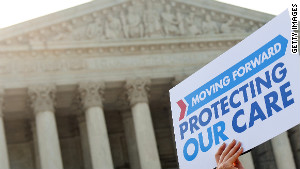
Follow him on Twitter. With the Supreme Court's thunderbolt, a crucial battle is over on health care, but the war surely goes on. Or does it?
There has been a widespread view among conservatives that if the court were to uphold Obamacare that would do more to galvanize the tea party and other parts of their base than any other outcome. Anger and frustration can be powerful motivators in politics.
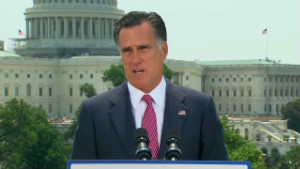
On cue, Mitt Romney immediately seized upon the court's decision to whip up Republican voters, arguing that now the only way to replace Obamacare is to replace President Obama. House Republicans are promising a quick, symbolic vote to overturn the law after July Fourth. And conservative groups are preparing to pour in millions of dollars in ads against the Patient Protection and Affordable Care Act that will begin hitting as early as Friday.
David Gergen
David Gergen
Opinion: Health care victory, but still a long way to go
Clearly, the war moves to a new front as far as the right is concerned. And in truth, the GOP should be able to mobilize a higher turnout from its base this November.
But the base alone will not be enough to win: The GOP also needs to draw in boatloads more of moderate and centrist voters. And whether those folks are going to welcome new rounds of fighting over the health care law remains to be seen.
My hunch is that a sizable number will think the war over health care has gone on long enough, and they will want to move on to more important issues. Jobs and deficits have long been trumping health care around most dinner tables.

 
Obama: It's a victory for the people
 
Romney: I'll do what justices didn't
 
How will the court's ruling affect you?
 
Short-term loss for conservatives?
 For better or worse, the court struggle came to be seen as the decisive battleground in trying to repeal the health reform law. Partisans on both sides, along with the press, created an expectation that the court would strike down the mandate, the keystone in the arch. Obama would be shown as another ineffectual Jimmy Carter, losing much of his authority.
Opinion: Liberty lost? The Supreme Court punts
But now that the court has spoken definitively on behalf of Obama -- and even Chief Justice John Roberts sided with the president -- there is likely to be a sense that the dam has broken. Especially among those who have been ambivalent about health care reform legislation -- and there are millions who like portions of it even though they don't much like it overall -- psychology may change. "Time to give it a rest; let's get our focus back to the economy."
How the public responds to the health care decision over the next couple of weeks will be critical. This is a moment when tides could shift.
Obama was smart in his reaction to the court: He didn't gloat too much over his huge victory, and he left open the door to alterations in the law in the months ahead. After some weeks of stumbling, he seemed presidential.
Romney is riding a tiger: To stay on top, he must continue to give voice to the tea party -- and if he falls off, as the joke goes, they will eat him. But a series of strident attacks against Obama and his health care plan will not be enough. To win, he must also reach voters beyond his base, showing that he understands their concerns and will speak for them, too.

Wildfire evacuee: Burglary 'almost as bad as the house being burned down'

Homes destroyed by the Waldo Canyon fire are seen from the air in a neighborhood on Saturday, June 30, in Colorado Springs, Colorado.The massive fire has destroyed hundreds of homes and forced more than 36,000 people to flee. Hundreds displaced by a fast-moving wildfire outside Colorado Springs, Colorado, will get their first look Sunday at what remains of their homes when authorities begin bus tours of burned out neighborhoods.
Authorities were still tallying the toll over the weekend from what state officials described as the worst fire in the state's history, though preliminary estimates by fire officials put the devastation at nearly 350 homes destroyed and more than two dozen damaged. Two people were killed and two were wounded in the fire, authorities said.
By early Sunday morning, firefighters contained 45% of the so-called Waldo Canyon fire, which has scorched more than 17,600 acres -- close to 27 square miles -- since it began June 23.
Firefighters, aided by helicopters, air tankers and military planes dropping water and retardant, fought to contain the inferno that early Sunday was still threatening 15,000 homes and 140 businesses, according to InciWeb, a multi-agency fire response website.
Crews were working through the early morning hours, fighting spot fires that could flare up and make a run at threatened communities.
"If we can get in and clean things up tonight, it will really help," said Kim Soeper, a fire chief overseeing night firefighting operations, Saturday night.
The city has organized the tours, which will continue through Monday, for about 4,000 people in neighborhoods that were either damaged or destroyed by the wildfire.
"You'll be able to look at your property," Steve Cox, assistant to the Colorado Springs mayor, told reporters over the weekend. "You're not going to be able to get out and walk around the property because we're still in an active fire situation."
The fire forced the evacuation of more than 36,000 people, most on Tuesday when strong winds whipped the blaze into a firestorm that spewed ash and smoke.
Many have since been allowed to return. Authorities are no longer keeping track of how many people are still evacuated, said Anne Rys-Sikora, a spokeswoman for the U.S. Forest Service.
But thousands early Sunday were still waiting for word when they would be able to go home.
Among those who no longer have a home is Nicole Frye. She learned her house was among those destroyed when the wildfire roared down the mountain into the western subdivisions of Colorado Springs.
Frye has not returned yet but has seen the devastation in aerial photographs.
Authorities warned Saturday that those returning home should be on the lookout for wild animals, including bears, driven into communities by the wildfire.
They also warned residents to be on the lookout for possible burglars targeting houses vacated by mandatory evacuations.
More than 150 National Guard soldiers were deployed to Colorado Springs to back up police, who are investigating nearly two dozen burglaries or attempted burglaries in the evacuation zones.
Linda Burton evacuated her suburban home because of the advancing wildfire only to return to find out her house was burglarized.
"It's almost as bad as the house being burned down because you feel violated that there are people out there that prey upon victims that are already suffering," Burton told CNN affiliate KKTV.
"I feel like I have been hit by a train."
But there are signs of progress in Colorado Springs, says Cody Muth, a graduate student at the University of Colorado.
"It's still a little strange," said Muth, who days earlier helped a friend flee the firestorm.
Stores and gas stations, he said, have begun to reopen. The heavy smoke that blanketed portion of the city for days has also begun to lift.
But still, he says, people are wary.
"It's just kind of hard to cope with. Your city was on fire, and every day you see a new plume of smoke in the distance," he said.
"That's how all of this started, a plume of smoke in the distance."
Authorities put the cost of fighting the fire at $8.8 million by Saturday night. The U.S. Forest Service has warned it could be mid-July before the Waldo Canyon Fire is fully under control.
The wildfire is one of 11 active fires in Colorado. Other Western states -- including Idaho, Wyoming, and Utah -- also are battling wildfires, which is straining firefighting resources.
President Barack Obama declared Colorado a disaster area to allow federal dollars to help fight the Waldo Canyon Fire as well the High Park Fire, which burned 87,284 acres and destroyed nearly 260 homes in northern Colorado since it began on June 9.
As of Saturday night, that fire was 100% contained and all evacuation orders were lifted. Firefighters will continue mopping up hotspots along the perimeter of the fire, which has cost more than $38 million to date.

World powers agree on steps for Syria; blast shatters funeral

Watch this video

As a dozen delegations sat inside the U.N. headquarters in Geneva on Saturday, drafting a plan to end the bloody Syrian crisis, a large funeral procession made its way through a Damascus suburb, clapping and chanting loud slogans against the government.
The man they were burying was wrapped in a Syrian revolutionary flag and had allegedly been killed by government forces. The crowd waved additional flags and shouted for freedom.
Then there was a deafening explosion.
In what opposition activists say was a government-organized car bombing, 85 people were killed and more than 300 people were wounded, most of them in critical condition.
Activists posted videos to YouTube purportedly showing the moment of the bombing in Zamalka and its aftermath.
After the loud crack and orange flash of the explosion come moaning and screams of "Allahu Akbar" ("God is great") from every direction. As the brown dust clears, the carnage becomes visible: charred bodies, missing limbs, people cradling the wounded or helping them to their feet, and pools of blood.
The flag-wrapped body of the funeral victim was lying on the ground.
Syrian opposition members say it was a car bomb timed to hit the procession in front of the mosque.
An activist named Bassem, who spoke to CNN from a suburb near Zamalka, said snipers in army uniforms began firing on people in the morning, and that plain-clothed government "thugs" even went to the funeral.
The security forces even fired on the crowd in the bombing's aftermath, killing a doctor who was trying to help the wounded, said Bassem, who asked that his last name not be used.
The opposition Local Coordination Committees of Syria said the scores dead in Zamalka were among 174 people killed across the country Saturday.
Photos: In Syrian hospital, no escape from war
CNN cannot independently confirm the reports of casualties or violence because Syria restricts access by international journalists.
At almost the same time the bombing happened in Zamalka, members of the international community forged their most specific plan to date on how to deal with the violence that has raged in Syria ever since the uprising began there last year.
Former U.N. Secretary-General Kofi Annan called the meeting in his role as the special envoy for Syria, representing both the United Nations and the League of Arab States. Annan drafted a six-point peace plan for Syria more than three months ago, detailing steps for all sides to take, but it has yet to be implemented.
Those at the Geneva meeting agreed that the first step should be a recommitment to a cease-fire by both sides and implementation of Annan's plan without waiting for the actions of others, Annan said.
Read the final communiqué from world diplomats (pdf)
A key to the process will be a transitional government, which Annan said could include members of the current Syrian regime. That makes it possible for President Bashar al-Assad to be a part of the transition, but Annan pointed out it is the Syrians who will decide the make-up.
"I think people who have blood on their hands are hopefully not the only people in Syria," Annan said after the meeting. "I think the government will have to be formed through discussion, negotiations, and by mutual consent. And I will doubt that the Syrians -- who have fought so hard for their independence, to be able to say how they're governed and who governs them -- will select people with blood on their hands to lead them."
U.S. Secretary of State Hillary Clinton said the plan also makes clear the Syrian president cannot stay in power.
"Assad will still have to go. He will never pass the mutual consent test, given the blood on his hands," she said.
Zakaria: How to avoid a wider war in Syria
The agreement also calls on the Syrian government to release detainees and allow journalists access to the country. The right to peaceful demonstrations must be respected, Annan said.
Clinton said it is significant that all of the countries at the meeting were able to come to an agreement.
"Every day that has gone by without unity on the Security Council and among the states gathered here is a day that has given comfort to Assad and his cronies and supporters. What we have done here is to strip away the fiction that he and those with blood on their hands can stay in power," she said.
Clinton said the the U.N. Security Council should endorse the plan, thus allowing the possibility of sanctions against Syria if the requirements aren't met.
Russian Foreign Minister Sergey Lavrov said that the document should not be interpreted as outside powers imposing a transitional government on the Syrians. That process, he said, must come from inside Syria.
Annan was the one who called Saturday's meeting, inviting top diplomats from the five permanent members of the U.N. Security Council and envoys from Turkey, the United Nations, the European Union and the Arab League.

Astrology and Cosmolgy in the World's Religions

It's a shocking fact that there has never been a human culture which has not related its myths, institutions and identity to the stars. This is as true of the modern West as it was of our stone-age ancestors, and is as relevant to the last, surviving, indigenous inhabitants of Amazonia, as it is of today's American astronomers. After all, no scientist spends cold nights scanning the sky in search of new stars, or long hours decoding data from deep space, if the exercise is completely meaningless. Actually, it is profoundly meaningful and the last hundred years' worth of discoveries of the immense, incomprehensible size of our universe, combined with the sheer wonder of recent color-enhanced images of distance galaxies has proved as enchanting as any ancient story of star gods and goddesses, or of saviors descending to earth from the sky.
The name we normally give to the quest for meaning in the sky is astrology, from the Greek logos -- 'word' or 'logic' of the stars -- as opposed to astronomy, the 'law' of the stars. Astrology in the modern world has a somewhat problematic relationship with the prevailing culture. Its most familiar form is the horoscope column, relying on 12 zodiac signs, divisions of the sky invented in Babylon sometime before 500 BCE, but perhaps with origins which predate the invention of writing. The system is a familiar part of mass culture but arouses peculiar ire amongst some fundamentalist Christians, who regard it as demonic, and a small but vocal coterie of skeptics, who regard it as a barbaric affront to Enlightenment values. In the modern religious wars secular atheists find themselves in an unholy alliance with born-again evangelicals against the representatives of a tradition which can be traced to before recorded history.
The word "astrology" with all its attendant baggage is, though, thoroughly Greek. The Arabic equivalent would be Ahkam al-Nudium, literally, "the decrees of the stars," and in India we talk about Jyotish, the "science of light." The Chinese might study tian wen, or sky patterns, while the Japanese base their practices on onmyodo, the "Yin-Yang way," the endless interplay of subtle forces in the cosmos. To the historian of religion, modern astrology is actually a remarkable survival from the pre-scientific, pre-Christian near east. Filtered through classical Greece, the Babylonian system became a universal language which could do anything from finding lost slaves, working out the most fortunate time to get married, making financial deals, or assisting in the soul's ascent to the afterlife. At the pinnacle of the system stood the mighty planetary deities -- Zeus, king of Olympus, for the planet Jupiter, Aphrodite, goddess of love, for Venus, and so on.
The Greek philosophers, being philosophers, couldn't help tinkering with the underlying rationale. Having capricious gods and goddesses sending messages to humanity via the stars wasn't good enough for rationally-minded Athenian intellectuals. They secularized the system, introducing notions of celestial influence, in which the planets might be hot or cold, wet or dry, with environmental conditions on earth shaped by celestial patterns. Time was installed as an organizing principle, almost a deity itself, in which astrology worked because planets and people moved together in a beautiful, synchronized ballet, experiencing periods of tension or relaxation at exactly the same moments. (The Greek Cosmos, the root of our word "cosmetic," is best translated as "beautiful order"). Intricate systems of causation were formulated in which the cause of present events might lie in the future -- backward causation as we would now know it. Such notions flourish today in India as an integral part of Hinduism, complimented by ancient Vedic teachings and, in the West they survive amongst a very small number of enthusiastic practitioners.
That the impulse to develop meaningful relationships between sky and society is universal is suggested by the evolution of completely distinct, sophisticated, systems of astrology in two other civilizations, the one in China and the other amongst the Maya and Aztecs of Mesoamerica. In both cultures astrology existed as a complex aid to management of the state, and as a simple means of fortune-telling: to be able to work out one's fortune -- one's prospects for success or failure, were as important then as they are now. There, as in the West, astrology could be chiefly seen as a form of risk-management.
Every human society relates the shapes (usually animals) it sees in the sky, along with the repetitive motions of sun, moon and stars, to every-day life. Amongst the First Nations of North America, the living, moving structure of the cosmos was -- and is -- enacted in rituals designed to harmonize with the greater life-field of which humans are a part. The Australian Aborigines promote their well-being by engaging with the Dreaming, the primeval but ever-present timeless dimension which can be expressed through such events as the rising and setting of stars, or the brilliant appearance of the New Moon in the evening sky, as much as in primeval patterns etched in the landscape. For the Polynesians, who sailed thousands of dangerous miles between small islands in tiny craft, the stars were an aid to navigation precisely because they were set in the sky by a friendly creator.
Astrology is central to religious practice on account of the opportunity it presents to contact celestial deities, or to synchronize human affairs with eternal truths. The most important features of devotional astrology are the sacred calendars which were established up long ago in order to identify the most auspicious dates -- and often times -- to perform religious rituals. The legacy is clear in Christmas, which dramatically borrowed 25th Dec., the Roman festival of the Unconquered Sun. Easter, adapting an ancient Babylonian festival, has Christ resurrected on the first Sunday -- the day sacred to the Sun -- after the first full moon following the spring equinox -- when day and night, light and dark, are equally balanced. The Hebrew rules, set out in the Old Testament could not be clearer: God will only take notice of such rituals if they are properly coordinated with the sun and moon. To do otherwise is to risk divine wrath.
The ancient zodiac signs survive in the modern West because, uniquely, in an age of aggressive consumerism, media-overload and scientific materialism, they encourage people to reflect on themselves and their inner worlds; their hopes, fears and secret motivations. In mass culture, astrology replaces the remote scientific language of relativity and light-years with stories of love and luck. In an era when we are now aware that we live on an insignificant planet on the edge of a minor galaxy, astrology restores each individual to the center of their own cosmos. According to its practitioners it provides a sense of personal meaning and purpose and, sometimes, a guide to action. Both astrology's advocates and its critics find rare agreement on this point. This has nothing to do with the truth of astrology's claims, but it does explain its survival in the 21st century.